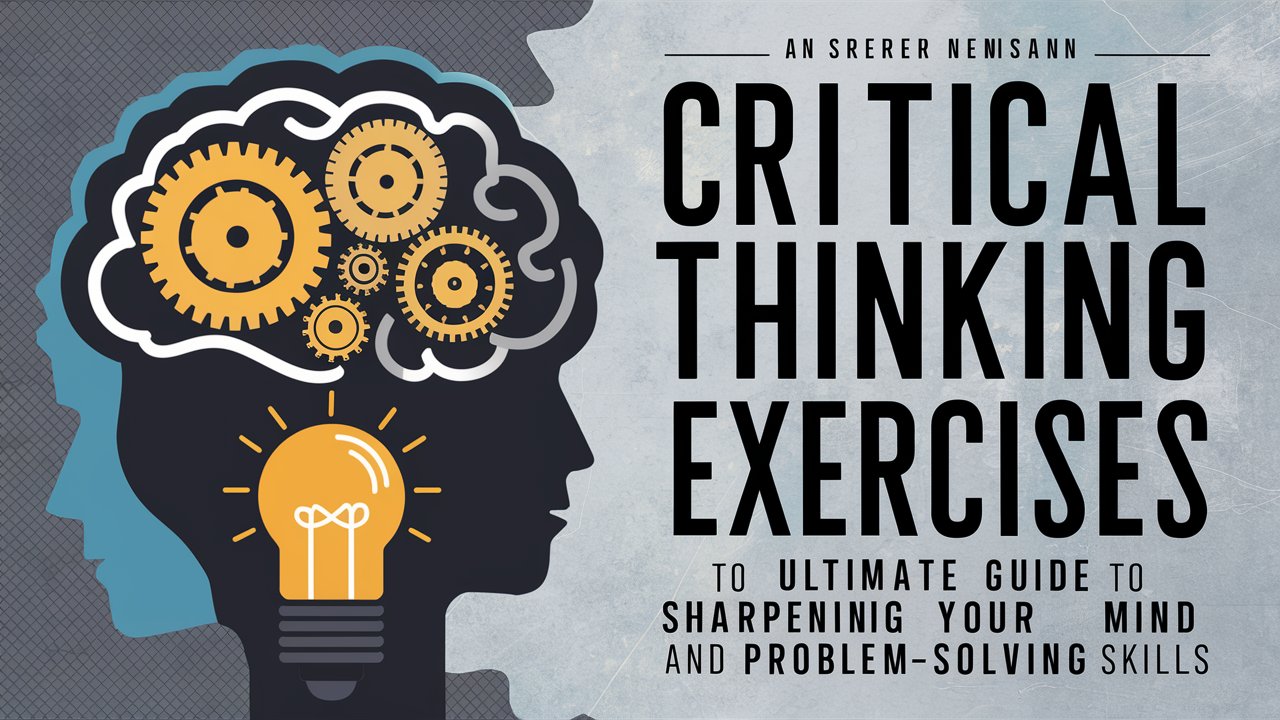
Critical Thinking Exercises: The Ultimate Guide to Sharpening Your Mind and Problem-Solving Skills
In an age of information overload, the ability to think critically has become one of the most valuable skills for personal, academic, and professional success. Critical thinking exercises are designed to help individuals analyze information objectively, evaluate evidence, and make reasoned decisions. These exercises go beyond memorization or passive learning—they encourage curiosity, creativity, and logical reasoning. Whether used in classrooms, workplaces, or personal development programs, critical thinking exercises help people strengthen their analytical abilities, improve communication, and make better judgments in complex situations. This article explores the importance of critical thinking, provides practical exercises, and explains how consistent practice can transform the way people approach challenges.
What Are Critical Thinking Exercises?
Critical thinking exercises are structured activities that challenge individuals to question assumptions, analyze information, and draw logical conclusions. These exercises encourage people to look beyond surface-level understanding and explore deeper meanings, relationships, and implications. They can take many forms, including puzzles, debates, case studies, problem-solving scenarios, and reflective writing.
The goal of these exercises is not to find a single “correct” answer but to develop the ability to think independently and evaluate multiple perspectives. In education, critical thinking exercises help students move from rote learning to analytical reasoning. In the workplace, they enable professionals to make informed decisions, solve complex problems, and communicate effectively.
The Importance of Critical Thinking in Everyday Life
Critical thinking is not limited to academic or professional settings—it plays a vital role in everyday decision-making. From evaluating news sources to managing finances or resolving conflicts, critical thinking helps individuals make rational choices based on evidence rather than emotion or bias.
In a world filled with misinformation and rapid technological change, the ability to think critically ensures that people can adapt, question, and innovate. It fosters intellectual independence, allowing individuals to form their own opinions rather than relying on external influences. Moreover, critical thinking promotes empathy and open-mindedness by encouraging people to consider different viewpoints before reaching conclusions.
Effective Critical Thinking Exercises
1. The “Five Whys” Technique
This exercise involves asking “why” five times in succession to uncover the root cause of a problem. For example, if a project fails, asking “why” repeatedly helps identify underlying issues such as poor communication, lack of planning, or resource constraints. This method encourages deeper analysis and prevents superficial conclusions.
2. Socratic Questioning
Inspired by the ancient philosopher Socrates, this exercise involves asking open-ended questions to challenge assumptions and explore reasoning. Questions like “What evidence supports this claim?” or “What alternative explanations exist?” help individuals think more critically about their beliefs and arguments.
3. The Perspective Shift Exercise
In this activity, participants analyze a situation from multiple viewpoints. For instance, in a workplace conflict, one might consider the perspectives of employees, managers, and clients. This exercise enhances empathy, reduces bias, and promotes balanced decision-making.
4. Problem Reversal
Instead of asking how to solve a problem, this exercise asks how to cause it. For example, “How can we make customer service worse?” Once the negative actions are identified, reversing them reveals effective solutions. This creative approach stimulates innovative thinking and helps uncover hidden insights.
5. Case Study Analysis
Analyzing real-world case studies encourages participants to apply logic and reasoning to complex scenarios. By evaluating data, identifying key issues, and proposing solutions, individuals develop practical problem-solving skills that can be applied in professional and academic contexts.
6. Brainstorming with Constraints
Traditional brainstorming encourages free thinking, but adding constraints—such as limited time, budget, or resources—forces participants to think more strategically. This exercise mirrors real-world challenges where creativity must operate within boundaries.
7. Logical Puzzles and Riddles
Engaging with logic puzzles, riddles, or strategy games like chess enhances analytical thinking and pattern recognition. These exercises train the brain to identify relationships, anticipate outcomes, and make reasoned decisions under pressure.

Benefits of Practicing Critical Thinking Exercises
Regularly engaging in critical thinking exercises offers numerous cognitive and emotional benefits. It improves problem-solving abilities by teaching individuals to approach challenges systematically rather than impulsively. It also enhances communication skills, as critical thinkers can articulate their ideas clearly and support them with evidence.
Moreover, critical thinking fosters creativity by encouraging people to explore unconventional solutions. It strengthens emotional intelligence by promoting empathy and understanding of diverse perspectives. In professional settings, employees who practice critical thinking are better equipped to handle uncertainty, adapt to change, and make strategic decisions that drive success.
How to Develop Critical Thinking Skills
Developing critical thinking requires consistent practice and reflection. Start by questioning assumptions and seeking evidence before forming opinions. Engage in discussions with people who hold different viewpoints to broaden understanding. Reading diverse materials, from scientific journals to philosophical essays, also helps expand analytical thinking.
Another effective strategy is journaling—writing about daily experiences and analyzing decisions made throughout the day. This reflective practice helps identify patterns in thinking and areas for improvement. Over time, these habits cultivate a mindset that values logic, curiosity, and continuous learning.
Why Critical Thinking Exercises Are Essential in Education and Work
In education, critical thinking exercises prepare students for real-world challenges by teaching them how to analyze information, evaluate arguments, and make informed decisions. They move beyond memorization, encouraging students to apply knowledge creatively and independently.
In the workplace, critical thinking is a cornerstone of leadership and innovation. Employers value employees who can assess risks, solve problems, and think strategically. Teams that engage in critical thinking exercises are more collaborative, adaptable, and capable of driving organizational success.
Conclusion
Critical thinking exercises are powerful tools for developing analytical, creative, and logical reasoning skills. They empower individuals to question assumptions, evaluate evidence, and make sound decisions in every aspect of life. In a world that demands adaptability and innovation, critical thinking is not just a skill—it is a necessity. By practicing these exercises regularly, students, professionals, and lifelong learners can cultivate sharper minds, stronger communication, and greater confidence in their ability to navigate complex challenges.
Frequently Asked Questions (FAQ)
1. What are critical thinking exercises?
Critical thinking exercises are structured activities designed to improve reasoning, analysis, and problem-solving skills through questioning, reflection, and logical evaluation.
2. Why are critical thinking exercises important?
They help individuals make informed decisions, solve problems effectively, and think independently in both personal and professional contexts.
3. Can critical thinking be taught?
Yes, critical thinking can be developed through consistent practice, guided exercises, and exposure to diverse perspectives and problem-solving scenarios.
4. What are some examples of critical thinking exercises?
Examples include the “Five Whys” technique, Socratic questioning, case study analysis, and logical puzzles that challenge reasoning and creativity.
5. How do critical thinking exercises help students?
They encourage students to move beyond memorization, analyze information critically, and apply knowledge to real-world situations.
6. Are critical thinking exercises useful in the workplace?
Absolutely. They enhance decision-making, teamwork, and innovation, making employees more effective and adaptable.
7. How often should I practice critical thinking exercises?
Practicing a few exercises weekly can significantly improve analytical and reasoning skills over time.
8. Can critical thinking improve creativity?
Yes, critical thinking and creativity complement each other by encouraging open-mindedness and innovative problem-solving.
9. What is the difference between critical thinking and problem-solving?
Critical thinking involves analyzing and evaluating information, while problem-solving applies that analysis to find effective solutions.
10. How can I start improving my critical thinking today?
Begin by questioning assumptions, seeking evidence for claims, engaging in discussions, and practicing exercises that challenge your reasoning and perspective.